KRKB Since March: Keeping Kids at the Center
Since the March safety post
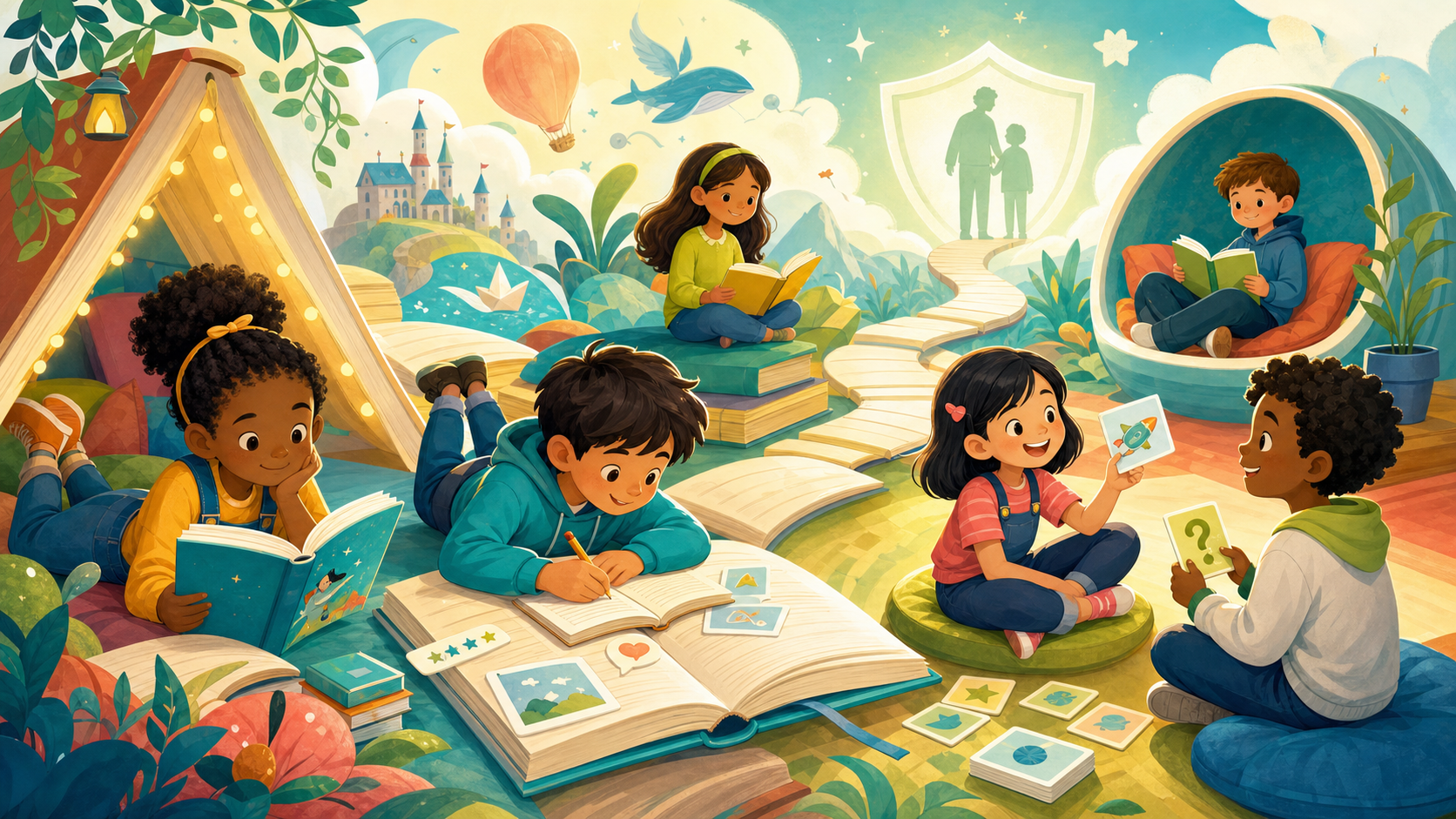
KRKB has moved from safety architecture into a fuller reading loop: children find books, respond in their own words, and adults get just enough trust, setup, and reporting structure to bring real groups into the experience.
Review
A reader explains why another kid should try the book.
Quiz
Practice stays tied to the books children are already reading.
Story
Creative responses have somewhere to go beyond a rating.
In March, the KRKB update was mostly about safety. That was the right first subject. A product for children does not earn the right to be playful until it has taken trust seriously.
But safety was never meant to be the whole story. Safety is the floor. The real product is what happens after a child feels comfortable enough to choose a book, react to it honestly, and share that reaction in a place that does not feel like ordinary social media or another school form.
Since March, KRKB has moved from a guarded reading community toward a fuller reading world. The work has been less glamorous than a launch headline and more important than one: make reviews easier to write, make discovery richer, make quizzes and stories feel connected to reading, give adults enough visibility to trust the space, and keep the child from feeling like the product has been taken away from them.
The Center Is Not the Institution
Kids do not wake up wanting an education platform. They want a next book. They want to know whether a series is worth starting. They want to say that the side character was better than the main character, or that the ending made them mad, or that a book was slow for four chapters and then suddenly impossible to put down.
That is the center of KRKB. Not the buyer. Not the dashboard. Not the plan page. The reader.
The adult-facing work matters because children need a protected environment, and because real groups of children usually arrive through a parent, teacher, librarian, or program organizer. But if KRKB ever starts to feel as if the adult workflow is the main event, the product will have drifted. The adult layer has to support trust while leaving the reading experience alone.
What has actually moved forward since March:
- Reviews remain the anchor. The core loop is still a child responding to a book in their own words, with moderation and community context around that voice.
- Discovery is deeper. Explore tags, category structure, age-aware book organization, shelves, wishlists, read lists, and peer recommendations all help children move from one book to the next.
- Quizzes have become part of the reading loop. They can support comprehension, practice, and challenge progress without turning every book into a worksheet.
- Stories give creative readers a second door. Some children respond to books by reviewing them. Others want to write, remix, extend, or invent. KRKB needs room for both.
- Reading Programs and challenges now have shape. Review Crew, Genre Explorer, seasonal reading, 30-day challenges, and Battle of the Books-style practice give groups a reason to keep going after the first login.
- The family loop is clearer. Parent-facing language, take-home instructions, activity summaries, and portal paths make it easier for adults to understand what the reader is doing without interrupting the reader.
- Moderation is more practical. Reviews, stories, quizzes, clubs, usernames, profiles, and group activity can be checked for privacy, kindness, age fit, unsafe links, and content that needs review.
- Reports now answer adult questions. Participation, reviews, quizzes, stories, top books, categories, challenge progress, and moderation signals can be summarized without making the child experience report-driven.
What Happens After the Click
Anushka's June KRKB essay, The Screen Time That Sends Students Back to Books, is the right lens for this update because it does not defend technology in the abstract. It asks what the tool causes a child to do next.
"The sharper question is not whether technology belongs in school. It is what a tool makes a student do next."
That is sharper than a generic founder story. It makes the product argument testable. A review should not be a decorative post; it should help a reader name what landed. A quiz should not be a worksheet with confetti; it should make attention visible. A shelf should not be a vanity collection; it should make the next book easier to find. A challenge should not turn reading into compliance; it should give momentum to a habit that still belongs to the child.
The trust work still matters because real groups need safer setup, family visibility, and adult review. But the product test is narrower than adoption language. After a child uses KRKB, are they closer to a book, a clearer opinion, a better question, or a conversation worth having? If the answer is yes, the screen did its job and got out of the way.
The Pilots Are a Pressure Test, Not the Identity
KRKB is now in the middle of U.S. school pilots. That matters. It means the product is being tested with real groups of children, real setup constraints, real adult questions, and real reading behavior.
But the pilots should not make the site sound as if KRKB is suddenly a school product first. The pilot setting is a way to learn. The reader remains the subject.
The questions are practical and human. Do kids write reviews when the prompt is clear but not heavy-handed? Which books make them want to talk? Do quizzes feel like play, practice, or homework? Can a child join a group without confusion? Can an adult review work quickly without hovering over every sentence? Can a parent understand the value in one minute? Can a challenge create momentum without making reading feel transactional?
Those are better questions than "Can this look impressive in a deck?" A polished deck can hide a weak product. A room of kids trying to use something usually cannot.
Reader Test
Does KRKB make a child more likely to find, finish, review, discuss, or recommend a book?
Trust Test
Can adults understand the safety, privacy, moderation, setup, and reporting paths without turning the experience into surveillance?
The Product Is Becoming a Loop
The strongest version of KRKB is a loop: discovery, reading, response, signal, support, and return.
A child discovers a book through a peer review, shelf, category, challenge, or recommendation. The child reads or samples it. The child responds: a review, a quiz, a story, a note, a discussion, a wishlist, a read-list add. That response gives another reader a signal. The group, parent, or adult organizer can see enough activity to support the habit. The child comes back because the next book feels closer.
That loop is why the less glamorous details matter. Age classification protects trust in discovery. Category tags make browsing feel specific instead of generic. Moderation protects the voice that reviews need. Parent notes keep families from feeling locked out. Impact reports help adults justify the time without making the child's page feel like an analytics surface. Battle practice and challenge templates give groups a shared rhythm, but the work still points back to books.
What Needs to Stay True
KRKB should feel kid-centered even when an adult created the program. The first screen should feel like reading. The review box should feel like a child's voice. The quiz should feel like a playful check-in. The story area should feel like creative response. The parent layer should support the child's agency.
The tone matters because children are very good at sensing when something has been built around them versus on top of them. A product can be safe and still feel alive. That is the line KRKB has to keep walking.
What I Am Watching Next
The next work is not to make KRKB more school-like. It is to make KRKB easier to bring to groups while preserving the child's feeling of ownership.
That means lighter setup, sharper first-day flows, cleaner group joining, faster moderation handoffs, more useful parent language, better challenge defaults, and more book discovery that feels personal. It also means listening carefully to the pilots for what children actually do, not what adults hope they will do.
If reviews are where the spark appears, the product should feed reviews. If quizzes become the bridge for certain readers, that bridge should get better. If stories reveal a different kind of reader, KRKB should honor that. If a setup step gets in the way, it should be simplified or removed. The product has to learn from behavior, not from slogans.
Where it stands
KRKB is past the safety-architecture-only stage. It now has enough reading, writing, discovery, moderation, family, program, challenge, and reporting structure to test with real groups. The standard is still simple: does KRKB make reading feel safer, more social, and more worth talking about for children?